
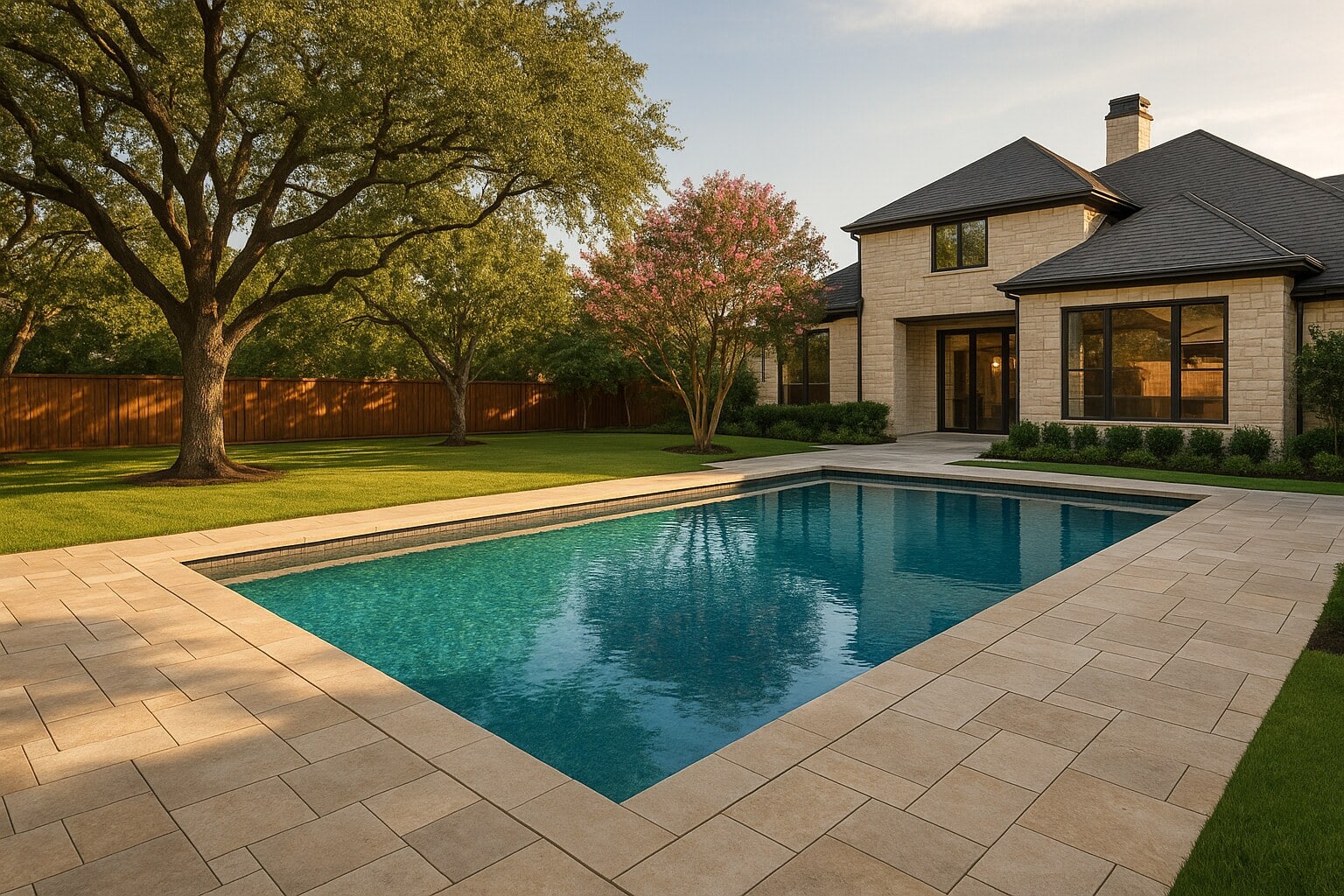
Coppell sits between Grapevine Lake and the northwest corner of Dallas County, a small city built out mostly in the 1980s and 1990s and filled in more recently with gated developments like Blackberry off Sandy Lake Road. That mix matters more than most homeowners expect when I show up to look at a backyard. An Old Town Coppell lot near Denton Tap Road has mature pecan and oak trees, an established fence line, and a patio that was probably poured in 1994. A lot in a newer section off MacArthur Boulevard has none of that history, but it comes with a stricter HOA architectural committee and a tighter buildable envelope once you account for setbacks and the drainage easement.
I’ve built gunite pools across both versions of Coppell, and the design conversation starts differently each time. On an established lot, I’m reading the yard, the tree canopy, and where the afternoon sun actually lands in August. On a newer lot, I’m reading the HOA covenant and the plat first, because that paperwork decides what I can build before the soil ever gets involved.
What sets Coppell apart from the cities around it
Coppell is landlocked between Grapevine, Irving, and Valley Ranch, and a lot of the families I meet with moved here for the school district and the short commute to the corporate offices clustered near DFW Airport. That means the homeowner across the table has usually thought hard about resale value and how the backyard functions for a family that entertains on weeknights, not just weekends. It changes the design brief. I hear fewer requests for a showpiece pool nobody uses and more requests for something that gets swum in most days from April through October.
The city itself runs its own permitting, unlike some of the MUD-governed communities I work in further north. That’s generally a smoother process, but Coppell’s building department is thorough about drainage plans, since parts of the city sit low relative to Denton Creek and its tributaries. I account for that in every grading plan before I ever submit for permit.
Neighborhoods vary block to block. Village at Cottonwood Creek and Riverchase have mature landscaping and established patios I’m usually working around rather than replacing outright. The Woodhurst and Lakeside sections tend to run smaller, more standard suburban lots where every foot of the design has to earn its place. Blackberry, the newer gated community east of MacArthur, has some of the largest lots in the city, several over 20,000 square feet, and gives me room to design a pool, spa, and full outdoor kitchen without the layout feeling forced.
Designing for Coppell’s soil and lot conditions
Coppell sits on the same blackland prairie clay that runs through most of Dallas and Denton County. It’s dense, dark, and expansive, meaning it swells noticeably after a wet spring and pulls back hard during a dry August. I don’t build a pool shell without a soils report specific to that lot, because two properties three doors apart can carry different plasticity index numbers, and that number drives how much steel goes into the beam and floor.
Every gunite pool I build is engineered to move with that clay rather than fight it. Skipping the soils report to save a week on the front end is how homeowners end up with a cracked bond beam five years later, and I won’t cut that corner regardless of the schedule pressure.
Established Coppell lots bring a second variable: root systems. A pecan or live oak that’s been in the ground for thirty years has roots running well past the drip line, and I plan excavation routes and equipment pads around them rather than through them wherever the layout allows. On the newer Blackberry-style lots, the trees are young enough that root protection isn’t a factor yet, so the constraint shifts to the HOA’s architectural guidelines instead, which in that community review fence height, equipment screening, and hardscape material before anything gets poured.
Architectural steel built for Coppell’s mixed lot conditions
Every structural steel element I install on a Coppell project is designed, engineered, and fabricated in my own shop, not handed off to a third-party welding contractor who has never walked the yard. That matters most on Coppell’s older, established lots, where a mature tree canopy or a tight side yard between two closely set homes leaves very little margin for a poor fit.
A modern architectural canopy is often the right call on the Woodhurst and Lakeside lots, where the buildable width between the house and the fence line is too narrow for a standard pergola kit to clear both the equipment pad and the walkway. I engineer the canopy’s footing and span to that exact width instead of working backward from a stock size. Because the engineering and welding both happen under my roof, I can adjust mid-process if a survey turns up an easement or a root zone I need to build around. I go into more depth on how these steel structures get engineered and fabricated for a specific lot on a dedicated page, worth a look before you sketch a covered outdoor kitchen.
What a custom pool costs in Coppell
A gunite pool with a spillover spa on a standard Coppell lot typically starts in the mid $80,000s and moves up from there based on size, tile selection, and decking material. Add a covered outdoor kitchen, architectural steel, or a larger water feature, and a full backyard build on one of the larger Blackberry lots can run well past $150,000.
The bigger swing in Coppell pricing usually comes from what the lot requires before construction starts rather than the pool itself. Established lots with mature trees often need root barrier work and careful excavation planning that a bare lot doesn’t. Newer HOA sections sometimes require specific screening materials or fence modifications that add cost before the first shovel goes in the ground. I walk through all of that in the initial estimate rather than surprising anyone with a change order once the crew is on site.
For homeowners who want to spread the cost out, I work with financing partners who understand how custom construction draws actually work. My pool financing guide covers the options I recommend most often.
Pool equipment for Coppell’s water and climate
Coppell’s municipal water runs hard, similar to the rest of the metroplex, which means scale buildup on tile and equipment is a real consideration if the filtration system isn’t sized correctly from the start. I spec variable-speed pumps on every Coppell build because they handle the filtration load at a lower flow rate, which cuts energy costs and reduces wear on the system over the life of the pool.
Salt water chlorination is popular with the families I build for in Coppell, mostly because it cuts down on the chemical handling that comes with a traditional chlorine feed. It’s not automatically the right call for every pool, though, and I walk every homeowner through the trade-offs between salt, standard chlorine, and ozone or UV systems based on how the pool actually gets used. My filtration and equipment guide covers that comparison in full.
Winter freeze protection matters here too. Coppell sees hard freezes most years, and equipment that isn’t properly insulated or automated for a freeze cycle can crack a pump housing or a backwash valve overnight.
Renovating an older Coppell pool
A good number of the pools in Old Town Coppell and Village at Cottonwood Creek were built in the 1990s and early 2000s, which puts them at the age where plaster is stained, tile lines are cracked, and the original equipment is well past its expected life. I get a steady stream of calls from homeowners who bought one of these houses and want the pool to actually match the rest of the renovation they’re doing on the home.
A standard pool renovation in Coppell usually covers replastering, retiling, and equipment upgrades, and it’s common for me to add a tanning ledge, a raised spa, or updated lighting the original build never had. A replaster and retile job runs two to three weeks. Add structural changes like a new spa or a reshaped shallow end, and the timeline stretches to six to ten weeks depending on scope.
Why an owner-built process fits Coppell
I’m on every Coppell job myself, from the first walk of the yard to the final fill. In a city with this much variation between an established Old Town lot and a new Blackberry lot, that continuity is what keeps a design accurate to the actual property instead of a generic template stretched to fit. I’ve written more about why that structure holds up better than a large builder’s project-manager model in my post on why a smaller, owner-run pool company outperforms a large company on custom work.
If you want to see how I plan a build from first sketch to final walkthrough before the numbers get discussed, my guide to planning a custom pool in DFW covers that whole sequence.
Comparing Coppell to nearby communities
Coppell borders Grapevine to the north, and I get asked often how the two compare. Compared to a custom pool project in Grapevine, Coppell lots tend to run smaller in the established neighborhoods and larger in the newer gated sections, which is close to the reverse of what I see in older Grapevine communities near the lake. Compared to the work I do in Southlake, Coppell’s HOA review process is generally lighter outside of Blackberry, and the city permitting office moves at a steadier pace than some of the larger Southlake committees.
None of that changes what a pool actually needs to hold up long term here: a gunite shell engineered for blackland prairie clay, equipment sized for hard water and hot summers, and a design that respects whatever the specific lot, old or new, actually gives me to work with.
Getting started on a Coppell pool
I start every Coppell project with a walk of the yard, a look at the HOA covenant if one applies, and a straight conversation about what the lot can support before I sketch anything. From there I put together a design and a written estimate based on that specific address, not a template pulled from the last job down the street.
If you’re considering a custom pool in Coppell and want to talk through what your lot allows, call me directly at 817.721.2452, or reach out through my contact page and I’ll get back to you myself.
Frequently asked questions
How long does a custom pool build take in Coppell?
Most of my Coppell projects run ten to fourteen weeks from groundbreaking to first swim, depending on the extent of HOA review, tree protection needs on established lots, and weather during the concrete and gunite phases.
Does Coppell require different permitting than nearby MUD-governed communities?
Yes. The City of Coppell handles its own permitting and inspections rather than a municipal utility district, which means the process runs through the city’s building department. Drainage review tends to be more thorough here given the low-lying areas near Denton Creek, and I account for that in the grading plan before I submit.
Can a pool be built around mature trees on an older Coppell lot?
In most cases, yes. I plan the shell placement, excavation route, and any architectural steel around the tree’s canopy and root zone rather than removing established landscaping. It takes more planning up front than a bare lot, but it’s achievable on the vast majority of Old Town and Cottonwood Creek properties I’ve worked on.
Why do pool costs vary so much between Coppell neighborhoods?
The pool itself prices fairly consistently based on size and features. What varies is what the lot requires before construction starts: root barrier work on established lots, HOA-required screening in newer sections like Blackberry, and drainage considerations tied to the property’s grade. I price all of that into the first estimate rather than adding it later.
Is Coppell’s water hard enough to affect pool equipment choices?
Yes. Coppell’s municipal water runs hard, similar to most of the metroplex, which affects scale buildup on tile and equipment over time. I size filtration and consider salt cell or scale-control options based on that water profile rather than a generic equipment package.
Will a pool project disturb existing landscaping in an established Coppell yard?
Some disruption during excavation is unavoidable, but I plan the access route, tree protection, and staging area to keep the footprint as small as possible. Fence panels are typically removed and reset rather than replaced, and I time the build so established landscaping has the best chance of recovering fully once construction wraps.