
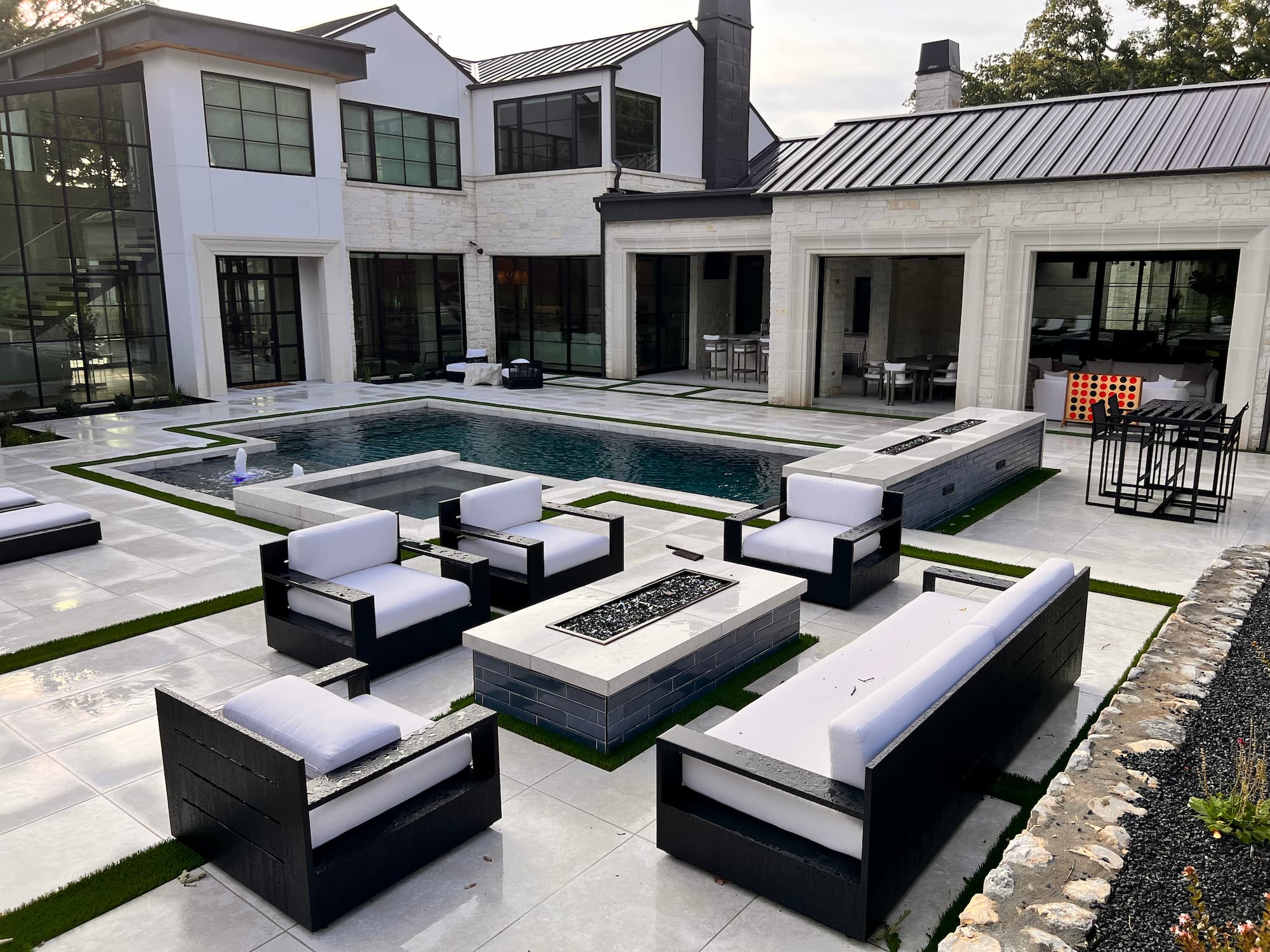
When homeowners across Westlake, Southlake, Colleyville, and the surrounding DFW luxury markets start planning a custom pool, the conversation almost always begins with shape, finish materials, and water features. Those are the decisions you can see. But the decision that determines whether your pool actually performs — whether the water stays crystal clear, the equipment runs quietly, and your energy bills stay reasonable for the next fifteen years — is the one most builders barely discuss: your filtration system.
Filtration is the engine room of your pool. It circulates every gallon of water through a filter medium, removes particulate matter too small for your skimmer to catch, and works in tandem with your sanitation system to keep the water safe and swimmable. A poorly specified filtration system — undersized pump, wrong filter type, inefficient plumbing — will fight you every week. A properly engineered one disappears into the background and lets you enjoy the pool instead of managing it.
This guide walks through the three filtration components that matter most — pumps, filters, and automation — the brands we trust after twenty-plus years of building across Grapevine, Keller, Flower Mound, Frisco, and the broader DFW metroplex — and what to look for when your builder hands you an equipment proposal.
The Three Components of Every Pool Filtration System
Every residential pool filtration system has three core components working together:
- The pump — moves water from the pool through the filter and back. It’s the heart of your circulation system, and the single biggest driver of your pool’s energy consumption.
- The filter — traps debris, dirt, oils, and microscopic particles as water passes through. Three types dominate the residential market: cartridge, sand, and diatomaceous earth (DE).
- The automation controller — manages pump speed, filter cycles, heating, lighting, and water features from a single interface. Optional but increasingly standard on custom builds.
The quality and sizing of these three components determine how clean your water stays, how much energy you burn, and how much maintenance your pool demands week after week. Getting any one of them wrong creates problems that no amount of chemical balancing will fix.
Pool Pumps: Why Variable Speed Changes Everything
If there’s one piece of pool equipment that has genuinely transformed how modern pools operate, it’s the variable speed pump. And if you’re building or renovating a pool anywhere in the DFW area — whether in Park Cities, Argyle, Trophy Club, Coppell, or Roanoke — this is the single most important equipment decision you’ll make.
Single-Speed vs. Variable Speed
Traditional single-speed pumps run at one fixed RPM — full power, all the time. They’re cheap to buy and expensive to run. A typical single-speed pump on a DFW pool costs $80 to $150 per month in electricity during swim season.
A variable speed pump adjusts its motor speed to match the task. Filtration doesn’t require full power — running at 1,500 RPM instead of 3,450 RPM moves the same volume of water at a fraction of the energy cost. The physics are dramatic: cutting pump speed in half reduces energy consumption by roughly 75 percent. Most DFW homeowners who switch to variable speed see their pool energy costs drop to $20 to $40 per month.
Variable speed pumps are also significantly quieter — a meaningful consideration for Westlake and Southlake properties where outdoor living spaces are designed for conversation, not competing with equipment noise.
The Brands We Specify — and Why
After two decades of building custom pools across DFW, we’ve worked with virtually every pump manufacturer on the market. Three brands consistently deliver the reliability, efficiency, and longevity that our clients expect:
Pentair — Our Primary Specification
Pentair is our go-to pump manufacturer for the majority of Platinum Pools builds. Their IntelliFlo variable speed line has been the gold standard in residential pool pumps for over a decade, and their track record in North Texas conditions — extreme heat, long run seasons, hard water — is unmatched.
The Pentair IntelliFlo3 VSF (variable speed and flow) is what we specify most often. It monitors flow rate in real time and automatically adjusts to maintain optimal circulation regardless of filter condition, water features running, or plumbing resistance. For larger estate pools and builds with multiple water features, the IntelliFlo3 delivers consistent performance without oversizing the pump — which wastes energy and shortens equipment life.
Pentair backs their IntelliFlo pumps with a strong manufacturer warranty. You can review the full warranty terms on Pentair’s official warranty page.
Jandy — Premium Alternative
Jandy (a Fluidra brand) produces excellent variable speed pumps and is particularly strong in automation integration. Their Jandy VS FloPro series offers reliable performance and pairs seamlessly with Jandy’s iAqualink automation platform — a consideration for homeowners who want smartphone control of every pool function.
We specify Jandy equipment when the project’s automation architecture benefits from staying within a single manufacturer’s ecosystem, or when specific features of the Jandy pump line better serve the build’s hydraulic requirements. Review Jandy’s warranty information here.
Hayward — Reliable Workhorse
Hayward rounds out the three brands we trust for DFW pool builds. Their Hayward MaxFlo VS and Super Pump VS lines deliver solid variable speed performance at a competitive price point. Hayward’s strength is straightforward reliability — these pumps run quietly, hold up well in Texas heat, and come with comprehensive manufacturer support.
For renovation projects where the existing plumbing and equipment pad favor a Hayward configuration, these pumps integrate cleanly without requiring a full replumb. Full warranty details are available on Hayward’s warranty page.
Pool Filters: Cartridge, Sand, or DE — Which Is Right for Your Build?
The filter is where the actual cleaning happens. Your pump pushes water through it, and the filter medium traps everything you don’t want in your pool. Choosing the right filter type depends on your pool size, usage patterns, surrounding landscape, and how much maintenance you’re willing to do.
Cartridge Filters
Cartridge filters use a pleated polyester element to trap particles down to 10–15 microns. They’re the most common choice for custom residential pools in DFW, and the one we specify most frequently.
Why we prefer them for most builds: Cartridge filters operate at lower pressure than sand or DE, which means less strain on your pump and lower energy consumption — a natural pairing with a variable speed pump. They also don’t require backwashing, which saves water and eliminates the need for a backwash line to your yard or drainage system.
Maintenance involves removing the cartridge every 4 to 8 weeks (depending on usage and debris load), hosing it down, and reinstalling. Replacement cartridges are needed every 1 to 3 years depending on how well they’re maintained.
The Pentair Clean & Clear Plus series and Jandy CL/CV series are our standard cartridge filter specifications. Both are built for the flow rates and debris loads typical of DFW pools.
Sand Filters
Sand filters push water through a bed of specially graded silica sand, trapping particles down to 20–40 microns. They’re the lowest-maintenance option — backwash every few weeks, replace the sand every 5 to 7 years — but they don’t filter as finely as cartridge or DE.
We occasionally specify sand filters for pools with heavy debris exposure (mature tree canopy, proximity to agricultural land) where the filter needs to handle high particulate loads without frequent element cleaning. For most luxury builds across Colleyville, Southlake, and the surrounding communities, cartridge filters are the better fit.
DE (Diatomaceous Earth) Filters
DE filters offer the finest filtration available — down to 2–5 microns. The water clarity they produce is genuinely noticeable. The tradeoff is higher maintenance: you need to add DE powder after each backwash, the grids require periodic deep cleaning, and the internal components are more complex than a simple cartridge.
For homeowners who prioritize absolute water clarity above all else — and are willing to invest in the maintenance or hire a pool service company to manage it — DE filtration is worth considering.
Pool Automation: The Brain Behind Your Filtration System
Automation isn’t strictly part of your filtration system, but it’s what ties the whole equipment package together — and it’s become a standard expectation on custom pool builds across DFW’s luxury markets.
A modern pool automation controller manages pump speed schedules, filter cycle timing, heater operation, lighting scenes, and water feature activation from a single panel or smartphone app. The two platforms we specify most often:
Pentair IntelliCenter — our primary automation platform. It integrates natively with Pentair pumps, filters, heaters, and salt systems, and offers robust scheduling, remote monitoring, and voice assistant compatibility. For builds where we’re specifying Pentair equipment across the board, IntelliCenter keeps everything in one ecosystem with zero compatibility issues.
Jandy iAqualink — a strong alternative, particularly when the project involves Jandy pump and heater equipment. The app interface is intuitive, and the system handles complex multi-zone configurations well for estate-scale pools with separate spa circuits, water feature zones, and landscape lighting integration.
Both platforms allow you to monitor and adjust your pool’s filtration cycles, chemical feeders, and energy usage from anywhere — something homeowners in Frisco, Flower Mound, and across DFW increasingly expect as standard.
How North Texas Weather Affects Your Filtration Equipment
DFW’s climate creates specific demands on pool filtration equipment that builders working in milder climates don’t have to consider:
Extended swim season. Most DFW pools run 8 to 10 months per year. That means your pump logs significantly more hours annually than pools in northern states — making efficiency and build quality critical for longevity.
Extreme heat. Summer temperatures routinely exceed 100°F, which accelerates algae growth and increases filtration demand. An undersized pump or filter that works fine in April will struggle in July and August when the biological load on your pool triples.
Freeze events. While rare, hard freezes do hit North Texas — as every DFW homeowner learned in 2021. Equipment that includes built-in freeze protection (standard on Pentair and Jandy variable speed pumps) automatically activates circulation during freezing temperatures to prevent pipe and equipment damage. If you’re interested in broader winter preparation, our Texas freeze preparation guide covers the full checklist.
Hard water and mineral content. North Texas municipal water tends to run high in calcium hardness and total dissolved solids. This accelerates scale buildup inside equipment, particularly salt cells, heater heat exchangers, and filter elements. Properly sized equipment running at efficient speeds develops less scale than oversized equipment cycling on and off.
What to Look for in Your Builder’s Equipment Proposal
When a pool builder hands you an equipment proposal, the filtration section should answer five questions clearly:
- Pump model, speed type, and horsepower — you should see a specific model number, not just “variable speed pump included.”
- Filter type, model, and square footage — filter sizing should match your pool volume and turnover rate. A 400 sq ft cartridge filter is appropriate for most residential pools; anything smaller on a large build is a red flag.
- Automation platform — what system controls the equipment, and what does it allow you to manage remotely?
- Plumbing sizing — 2-inch plumbing is the minimum standard for custom builds. Undersized plumbing creates back pressure that forces the pump to work harder, wastes energy, and shortens equipment life.
- Warranty terms — every piece of equipment should come with a manufacturer warranty, and your builder should register them on your behalf.
If the equipment section of your proposal reads “pump and filter included” with no model numbers, no specifications, and no brand names — that’s not a proposal. That’s a placeholder designed to keep the quoted price low while leaving room to install whatever’s cheapest at the time of construction.
At Platinum Pools, every proposal we write is fully itemized — equipment, materials, finishes, and labor broken out line by line. No allowances, no ambiguity, no surprises at installation.
Filtration and Your Pool’s Sanitation System Work Together
It’s worth noting that filtration and sanitation are two different systems solving two different problems — but they’re deeply interdependent. Your filter removes physical contaminants (dirt, debris, oils, skin cells). Your sanitation system (chlorine, salt, ozone, UV) kills biological contaminants (bacteria, algae, viruses).
When filtration is working efficiently, your sanitizer has less work to do. When filtration is undersized or poorly maintained, your chemical costs go up, your water clarity suffers, and your sanitation system gets overwhelmed. We covered sanitation methods in depth in our complete pool water sanitation guide — if you haven’t read it, it’s a natural companion to this post.
Pool Filtration System Upgrades for Existing DFW Pools
If you already own a pool in Westlake, Southlake, Colleyville, Keller, Grapevine, Park Cities, Frisco, Flower Mound, Argyle, Trophy Club, Coppell, Roanoke, or anywhere else in DFW, upgrading your filtration system is one of the highest-impact improvements you can make — and one of the most cost-effective.
Replacing a single-speed pump with a variable speed model typically pays for itself within 12 to 24 months through energy savings alone. Adding automation eliminates the daily guesswork of managing pump schedules and chemical feeders manually. And upgrading from a sand filter to a cartridge or DE filter noticeably improves water clarity.
We handle filtration upgrades and full equipment overhauls as part of our pool renovation services. Whether it’s a standalone equipment upgrade or a complete pool remodel, the process is the same — Adrian visits your property, evaluates what you have, and gives you an honest recommendation with a fully itemized proposal.
The Bottom Line on Pool Filtration
Your pool’s filtration system is the infrastructure nobody sees and everybody benefits from. The right pump, filter, and automation platform — properly sized, properly plumbed, and specified from brands with proven track records in North Texas conditions — is the difference between a pool that runs effortlessly and one that demands constant attention.
If you’re planning a new custom pool or considering an equipment upgrade on your existing pool, we’d welcome the conversation. We’ll walk your property (or your equipment pad), assess what you have or what you need, and give you a clear, itemized picture of what the right filtration system looks like for your specific pool and property.
Request Your Free Consultation →
Platinum Pools and Outdoor Living is a boutique custom pool builder serving Westlake, Southlake, Park Cities, Grapevine, Colleyville, Keller, Flower Mound, Frisco, Argyle, Trophy Club, Coppell, Roanoke, and the greater DFW area since 2004. Owner-led builds. Eight to ten projects per year. One standard.
Thinking about upgrading your existing pool before adding new elements? Our pool renovation in DFW guide walks DFW homeowners through what to expect and when it makes sense.