
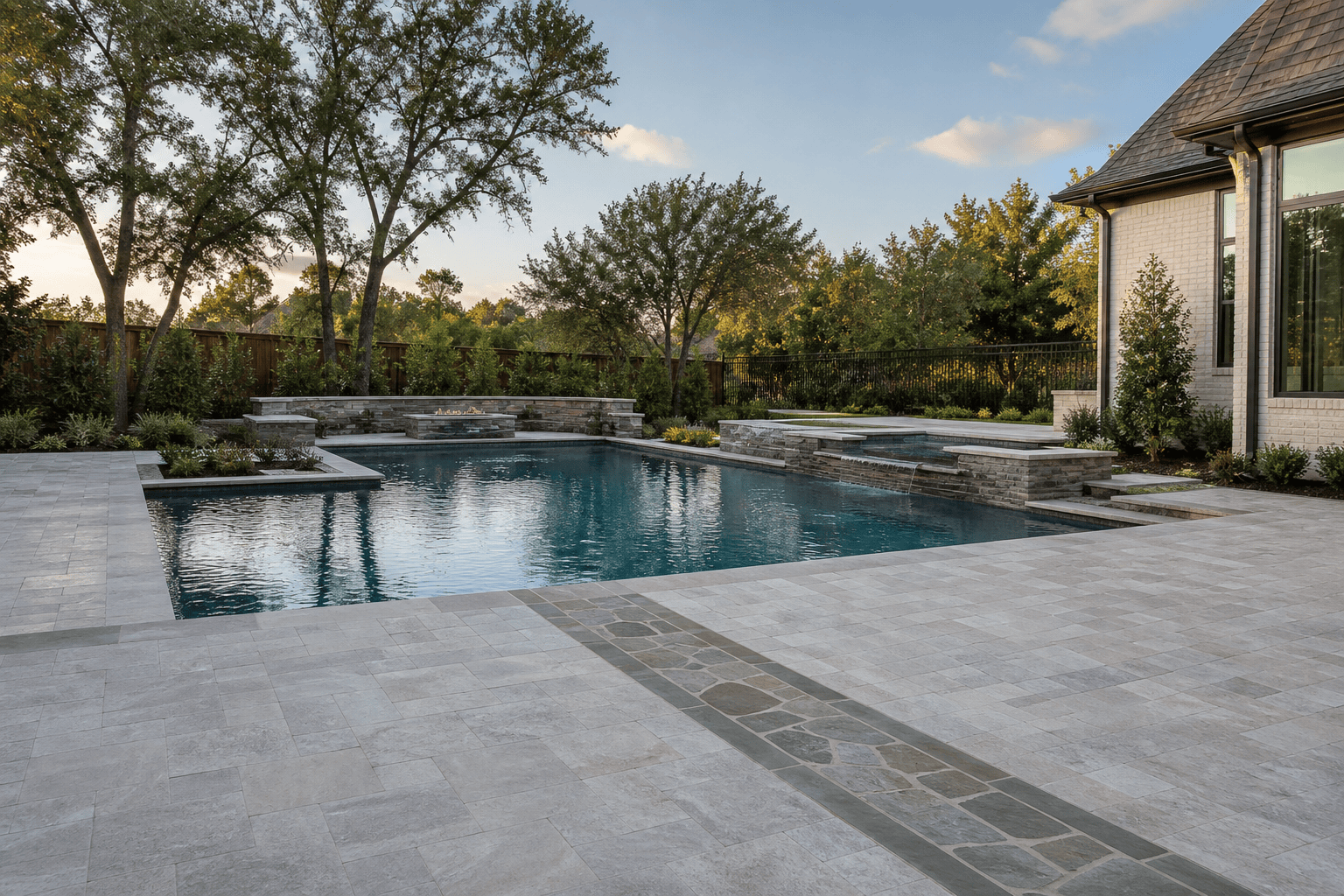
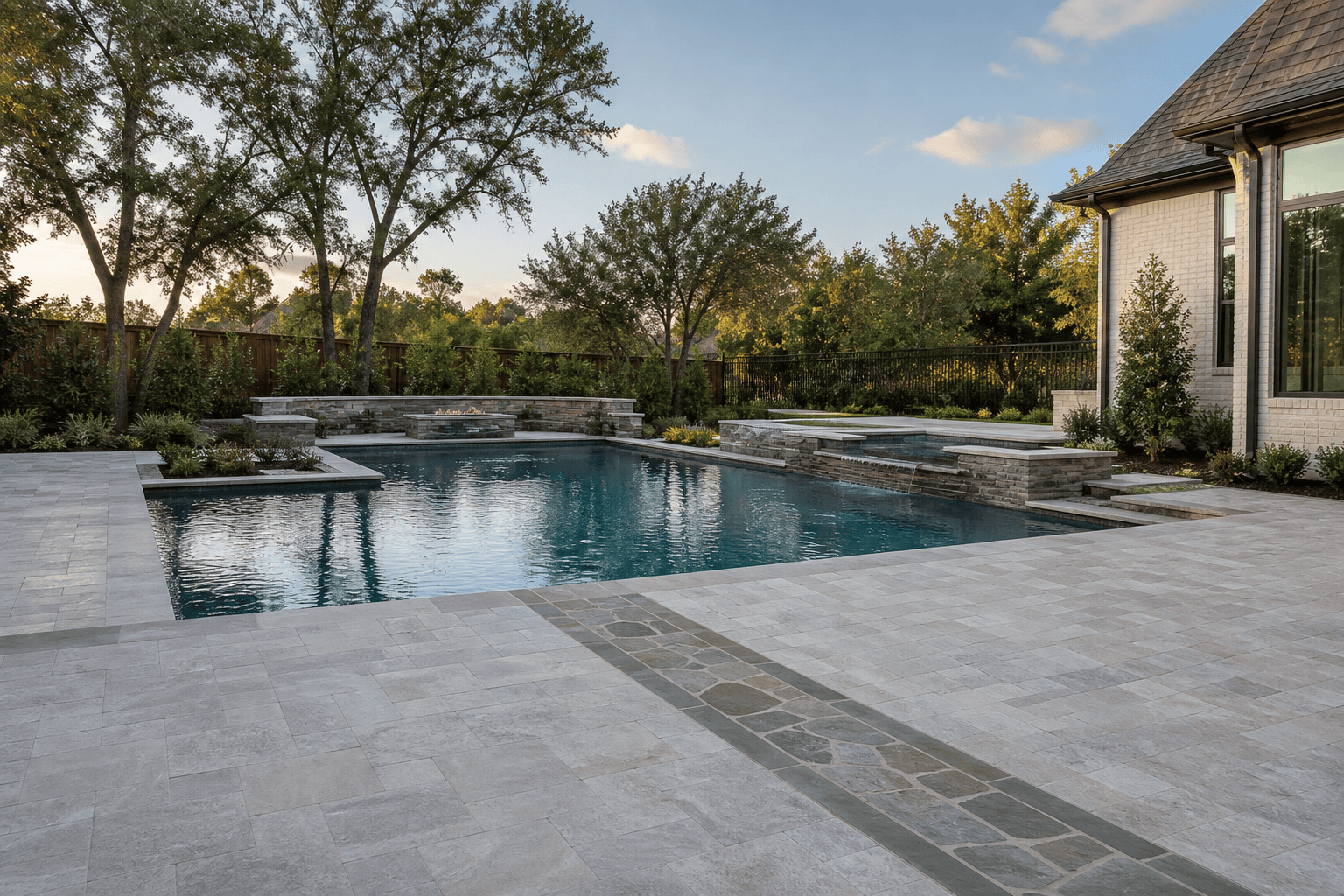
Pool decking is not a finish I leave until the end of design. It sets the walking surface around the water, establishes the visual relationship between the pool and the house, and affects how the backyard handles North Texas sun, rain, and everyday use. A deck can make a carefully planned pool feel grounded, or it can make the whole project harder to live with.
For a custom pool in DFW, I start with how the family will use the space. Bare feet, dogs, outdoor cooking, shade, furniture, drainage, and the amount of direct afternoon sun all matter. The material matters too, but it is only one part of the decision. Joint layout, coping, elevation, texture, and the transition into existing patios are just as important.
This guide covers the materials I discuss most often: travertine, flagstone, cool deck coatings, and poured concrete. Each can work in the right setting. The best choice comes from matching the surface to the house, the lot, and the way a family actually spends time outside.
Start with the layout, not the sample board
A small material sample cannot show how a deck will feel once it wraps a pool, connects to a back door, and carries furniture and foot traffic. Before I narrow the material, I work through the deck’s job. Does it need a wide dining area? Is there a path from the driveway that will bring dirt across it? Will a grill or outdoor kitchen sit on the same plane? Is there enough room for a chaise lounge without blocking the walk around the pool?
Those questions belong in the early pool-planning process, not after excavation. On a compact backyard, an extra two feet of usable deck along one side can be more valuable than a more elaborate material. On a larger lot, I can use changes in texture or joint direction to give separate areas a clear purpose without putting up walls.
Elevation is another early decision. A low deck that meets the home’s existing patio may be practical, but water still needs a route away from the house and pool. I look at grade, existing drains, roof discharge, and the way a deck will meet planting beds. In DFW, a sudden hard rain can reveal a poor drainage decision quickly.
Travertine: a practical natural-stone choice for many DFW pools
Travertine is a natural stone with a soft, varied surface and a range of warm neutral colors. It is common around custom pools because it can stay more comfortable underfoot than many dense dark materials in direct sun. Its visual character also works with a wide range of homes, from a traditional brick exterior to cleaner contemporary lines.
The open pores in travertine are part of its appearance. I discuss them plainly with homeowners before selection. Filled and honed pieces create a more refined look, while tumbled material has a more relaxed texture and edge. Neither is universally better. The choice depends on the home, the desired footing, and the amount of texture that makes sense near the water.
Travertine needs a thoughtful setting bed, proper joint treatment, and a layout that accounts for cuts at curves, steps, and equipment access. I also pay attention to color variation from pallet to pallet. Seeing a larger grouping of pieces before installation gives a much more useful sense of the finished result than selecting from a single tile.
For coping, I may use matching travertine or deliberately introduce a related material with a different edge profile. Coping is the hand and foot contact point at the pool, so its finish and overhang deserve as much attention as the deck. The waterline tile, plaster tone, and coping should be considered together rather than selected independently.
Flagstone: character, texture, and careful layout
Flagstone has more variation in shape, color, and texture than a cut stone deck. It can make a backyard feel established, especially beside mature trees, natural planting, or a home with stone on the exterior. It also gives a designer room to create a less formal path, terrace, or sitting area.
That variation is its strength and its constraint. Irregular pieces need an experienced layout so joints do not become awkward, narrow fragments do not collect in visible areas, and walking paths remain comfortable. I look at where people will enter the water, pull chairs back from a table, and carry a plate from the kitchen. A dramatic stone pattern is not useful if it creates troublesome footing at those points.
Flagstone can be especially effective as an accent rather than a full pool surround. I might use it for a fire-feature terrace, a transition toward a garden, or the patio around a seating wall, then use a more regular surface around the pool itself. That approach lets the material contribute texture without making every square foot feel busy. The broader hardscape plan should decide where each surface begins and ends.
Cool deck coatings: a useful option when an existing slab stays
“Cool deck” is often used loosely to describe textured acrylic coatings applied over existing concrete. This option can make sense during a renovation when the slab is structurally sound and a homeowner wants a new surface without removing all of the deck. The coating changes both the look and the underfoot texture of the concrete.
I do not treat a coating as a cure for a failed slab. Cracks, movement, poor drainage, or an incorrect elevation need attention before any finish goes on. If the foundation is stable and the deck has the right shape, a coating can offer a sensible reset. It is available in many colors and can be laid out with scoring lines that create a more intentional pattern.
Texture needs balance. Enough texture helps with wet footing, but an overly aggressive finish is uncomfortable for bare feet and difficult to keep clean. I also consider the color in full afternoon light. Very dark surfaces absorb heat, while very light ones can create glare. Samples should be viewed outdoors near the pool, not only inside a showroom.
For an older backyard, this decision often overlaps with broader pool renovation planning. A new coping line, waterline tile, surface coating, and updated lighting can change the entire setting, but I sequence that work around the condition of the concrete and the pool shell first.
Poured concrete: flexible, straightforward, and far from one look
Poured concrete remains a solid choice for pool decks. It can be broom-finished, lightly textured, stained, scored, exposed with aggregate, or detailed with saw-cut control joints. It also gives me flexibility where a deck must follow unusual geometry, meet an existing patio, or accommodate a large outdoor room.
The success of a concrete deck depends less on a decorative name and more on preparation, reinforcement, placement, control joints, drainage, and curing. In clay-heavy North Texas soil, I plan the deck with movement and water management in mind. A clean joint pattern can look deliberate while also doing necessary work.
Concrete is a good fit for a restrained modern design, particularly when the house already has crisp lines. It can also sit quietly behind more expressive pool elements. A perimeter-overflow look, a sculptural raised spa, or a water feature with a controlled sound profile may already give the backyard enough visual activity. The deck does not have to compete.
Coordinate decking with pool features
Deck material affects more than the space around the water. A tanning ledge needs a surface transition that feels clear and comfortable underfoot. Steps need visible edges. A raised spa needs a surround that works with its spillway and maintenance access. Lighting needs to be placed before hardscape closes off conduit routes.
For example, I review the deck and coping as part of tanning ledge and sun shelf design, because the ledge may be the most-used water-level area of the pool. I also review fixture locations with the pool lighting plan before the deck is poured or set. That prevents late compromises and makes night use feel considered rather than added afterward.
Furniture is another useful reality check. Marking the footprint of chairs, a dining table, or a grill on the ground before construction can show whether a selected deck layout has enough clear circulation. A pool should support an outdoor room, not make every activity happen in a narrow strip beside the coping.
In-house architectural steel for more useful shade and structure
Some deck plans need more than stone or concrete to work well. On DFW lots with limited rear setbacks or a house that opens directly onto the pool area, a cantilevered roof structure can create shade without placing columns in the middle of a dining or circulation zone. I design, engineer, and fabricate that steel in-house, rather than subcontracting it to a separate fabricator. That keeps the pool layout, drainage, roof line, and footing locations in the same conversation from the start.
A carefully proportioned steel canopy can also connect the pool deck to an outdoor kitchen or existing architecture without making a compact yard feel closed in. My custom architectural steel approach shows how those elements can be shaped around the constraints of a particular property. The decking then becomes part of a complete outdoor floor plan, with shade and circulation planned together.
Budget the deck as part of the project, not an allowance after it
Decking cost is driven by material, square footage, site access, demolition, drainage work, steps, coping, cuts, and the details where new work meets the existing house or patio. Natural stone generally brings more material and labor variation than a straightforward concrete finish. An existing deck that appears simple to cover can add cost if it needs removal, leveling, or structural repair first.
I prefer to establish the deck area and a realistic material direction early, then refine the exact selection as the design develops. That gives a homeowner better control over the parts of the budget that affect daily use. If the full scope needs to be phased, I identify what can be completed later without undoing finished work. Pool financing information can also help put the full project cost in context.
How I help narrow the decision
I bring the discussion back to a few practical questions: How much direct sun does the deck receive? How much texture is comfortable? Does the home call for a natural, varied surface or clean planes? Is the existing slab staying? What needs to drain across or away from the deck? Once those answers are clear, the material list usually gets shorter.
For homeowners planning a new pool, I can walk the lot, look at the home’s architecture, and discuss how the deck will support the pool and the rest of the backyard. My outdoor living work is planned alongside the pool when kitchens, shade, fire features, or seating areas are part of the goal. To start a conversation about a DFW project, call me at 817.721.2452 or use my contact page.
Frequently asked questions about pool decking materials in DFW
What pool deck material stays coolest in DFW summer sun?
Light-colored travertine is often comfortable underfoot compared with many denser or darker surfaces, but the result depends on color, finish, shade, and the amount of direct sun. A sample viewed outdoors is the best way to compare candidates for a particular yard.
Is flagstone suitable for a pool deck?
Yes, flagstone can work well around a pool when the pieces, joint widths, and surface texture are selected for barefoot traffic and wet areas. It is also effective as an accent material for a terrace or path paired with a more regular pool surround.
Can a cool deck coating go over old concrete?
A textured coating can be a good option when the existing concrete is stable, properly drained, and in sound condition. It should not be used to hide movement, significant cracking, or an elevation problem without addressing those issues first.
When should I choose the pool deck material?
Choose the general material direction during design, after the deck layout, drainage, and pool features are understood. Exact color and finish can be finalized later, but waiting until construction is underway can limit useful choices.