
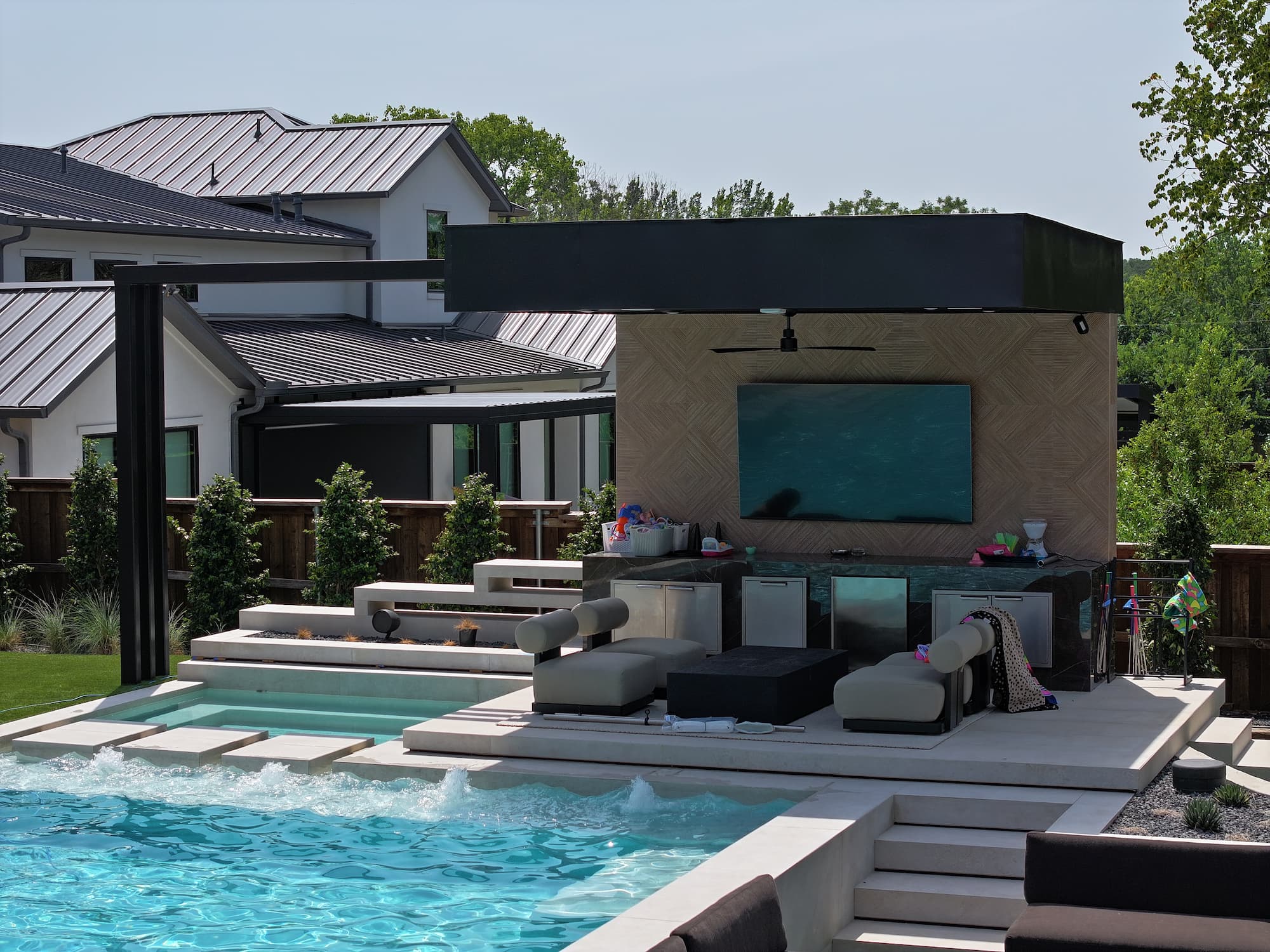
Most of the pool designs that stop you on Instagram — the ones with a roof structure that appears to float over the water, the fire wall that seems to defy gravity, the canopy that stretches impossibly across the deep end — share one thing in common.
They all require fully fabricated, engineered structural steel.
And most pool builders in DFW don’t do steel.
This post is about what that capability actually unlocks, why it matters for the kind of pool design that elevates a property rather than just adds to it, and why “we sub it out” is a very different answer than “we fabricate it in-house.” If you’re researching a custom pool and you’ve been quietly wondering why every builder seems to design the same kind of pool, this is the post that explains the ceiling you’ve been bumping into. You can also see examples of this work on our architectural steel features page.
The Design Ceiling Nobody Talks About
Here’s something that happens on a lot of DFW custom pool projects:
The homeowner comes in with a Pinterest board, a few magazine clippings, an architect’s rendering, or just a clear idea of what they want. The design includes some kind of dramatic structural element — a cantilevered roof extending from the house over the pool, a floating fire wall as an axis between the home and the water, an architectural canopy creating shade across the lounging area. Something that gives the project real architectural ambition.
Then they start meeting with pool builders.
And one by one, those structural elements get quietly negotiated away. Maybe the cantilever becomes a post-supported pergola. Maybe the floating fire wall becomes a low stone wall that sits on the deck. Maybe the canopy disappears entirely, replaced by some umbrellas.
The homeowner usually thinks this is about cost. It almost never is. It’s about capability. The builder is steering the design toward what they can actually build, and most DFW pool builders can’t fabricate structural steel — so anything requiring it gets removed from the design.
You end up with a competent pool. You don’t end up with the pool you came in wanting.
What Engineered Structural Steel Actually Unlocks
Four specific design elements depend on real structural steel work, and each one fundamentally changes what a pool can be.
Cantilevered roof structures. A roof that extends from the house out over the pool — with no visible support posts in the water — requires engineered steel framing tied back into the home’s structure. Done right, it transforms the relationship between indoor and outdoor space. The pool becomes an extension of the architecture, not a separate environment. Done wrong (or substituted with post-supported alternatives), you end up with poles in your sightlines and a roof that visually disconnects from the house.
Floating fire walls. A fire feature that appears to hover in space — typically positioned as a focal point between the home and the pool, often with water elements integrated — requires structural steel internal framing. The “floating” quality is the entire point of the design. Build it as a stone wall on a footing and you have a different, lesser object.
Modern architectural canopies. Large overhead shade structures that span significant distance without intrusive supports — clean, modern, architecturally significant — require engineered steel. Wood pergolas and post-supported structures can’t achieve the same span or the same visual lightness. The difference between an architectural canopy and a pergola is the difference between an architect-designed object and a kit.
Integrated structural shade elements. Cantilevered sun shelves, floating shade panels, integrated cabana structures that read as part of the pool rather than added to it — all rely on engineered steel work integrated with the pool’s structure from day one.
Each of these elements isn’t a luxury feature you bolt onto a normal pool. They’re design moves that change what kind of object the pool is.
Why “We Sub It Out” Isn’t the Same Answer
When you ask a pool builder whether they can do structural steel, the honest answers fall into three categories.
“No.” Most DFW builders. They’ll steer your design away from anything requiring it.
“Yes, we subcontract it.” A smaller number. This sounds fine, but introduces real problems. The steel sub has their own schedule, their own design preferences, and their own coordination requirements. The pool builder is now project-managing a trade they don’t fully understand, on a structural element that has to integrate precisely with the pool’s engineering. Things slip. Tolerances get fudged. Quality varies. And when something doesn’t work, the pool builder blames the steel sub, the steel sub blames the design, and the homeowner is stuck in the middle.
“Yes, we fabricate in-house.” Very few DFW builders. This is the difference between coordinating a trade and owning the trade. Steel design happens during pool design — not after. Engineering is integrated, not coordinated. The same team that builds your pool builds the structural elements that integrate with it. There’s no schedule risk from a sub, no coordination friction, no finger-pointing if something doesn’t align.
Platinum Pools and Outdoor Living is in the third category. We design, engineer, and fabricate structural steel in-house, as part of our pool design process — not as a separately-managed trade.
This is the single biggest reason architects, custom home builders, and design-conscious homeowners bring us into projects that other builders can’t fully execute.
What This Changes in the Design Process
When structural steel is in-house, the design process changes meaningfully.
Design starts earlier. We can sit in architectural meetings during the home design phase, contributing to decisions about how the house, the pool, and the structural elements relate to each other. We’re not arriving after the architecture is finalized to figure out where the pool goes.
Engineering is integrated. Steel structural elements get engineered as part of the pool’s structural system, not as a separate object trying to interface with it. The result is cleaner integration and fewer compromise points.
Schedule risk drops. We’re not waiting on a subcontractor’s calendar. Steel fabrication runs on our timeline, in coordination with the rest of the build.
Design ambition doesn’t get value-engineered down. When the team that owns the steel is the team designing the pool, ambitious structural moves stay in the design. They don’t get quietly removed because they’re “too complicated.”
For estate-tier projects, this changes the entire ceiling of what’s possible.
A Note on Cost
A reasonable question at this point: doesn’t this cost more?
Structural steel elements add real cost — typically $25,000 at the simpler end, $75,000+ for major cantilevered structures or architectural canopies. That’s not nothing.
But the comparison isn’t “with steel vs. without steel.” It’s “with the design you actually want vs. with a compromised design that costs nearly as much.” Most homeowners who go through this process discover that the alternative — a heavily post-supported pergola, a stone wall instead of a floating fire feature, umbrellas instead of an architectural canopy — costs almost as much as the steel solution and produces a dramatically less satisfying result. (For a fuller breakdown of where the money goes on a custom build, see our DFW pool cost guide.)
Cost is real. But on an estate-tier project, the cost of building something you’ll be dissatisfied with for the next twenty years is significantly higher than the cost of doing it right once.
Who This Matters For
Structural steel capability isn’t relevant to every pool project. If you’re building a $90,000 entry-level custom pool, you’re not in this conversation, and that’s completely fine — not every pool needs to be an architectural object.
This matters for:
- Custom home builds where the pool is part of the original architectural vision
- Estate-tier renovations where the existing pool’s surroundings are being completely reconceived
- Projects where the architect has drawn structural elements that need to actually get built
- Homeowners who came in with a Pinterest board full of pools that “no one in DFW seems to build” — usually because no one in DFW can build them
- Properties where the relationship between the house and the pool is itself the design problem
If you’re in one of these situations, the question of whether your pool builder can execute structural steel isn’t a “nice to have.” It’s the question that determines whether your project achieves what you came in wanting.
The Question to Ask
If you’re interviewing pool builders for a project that includes — or could include — structural elements, ask one question directly:
Do you fabricate structural steel in-house, or do you subcontract it?
The answer tells you which category of builder you’re talking to. And it tells you, more honestly than any portfolio image, what kind of project you’re going to end up with.
Ready to Talk About Your Project?
Platinum Pools and Outdoor Living is a boutique custom pool builder serving DFW’s luxury markets, and one of the only builders in North Texas with in-house engineered structural steel capability. We cap projects at 8 to 10 per year, the owner is personally on every job site, and we design steel elements as integrated parts of the pool from day one.
If you’re planning a project with real architectural ambition — or if you’ve been having conversations with builders who keep negotiating your design down — request a free consultation. We’ll walk your property, look at what you actually want to build, and tell you honestly what’s possible.
Request Your Free Consultation →
Steel isn’t just structural — it unlocks design possibilities. See how we’ve used architectural steel features in cantilevered kitchens, floating steps, and dramatic overhangs. Our builds in Westlake, Keller, and Frisco showcase what’s possible when engineering meets artistry. If your existing pool needs structural reinforcement, a renovation is the place to start. Contact us to discuss your project.