
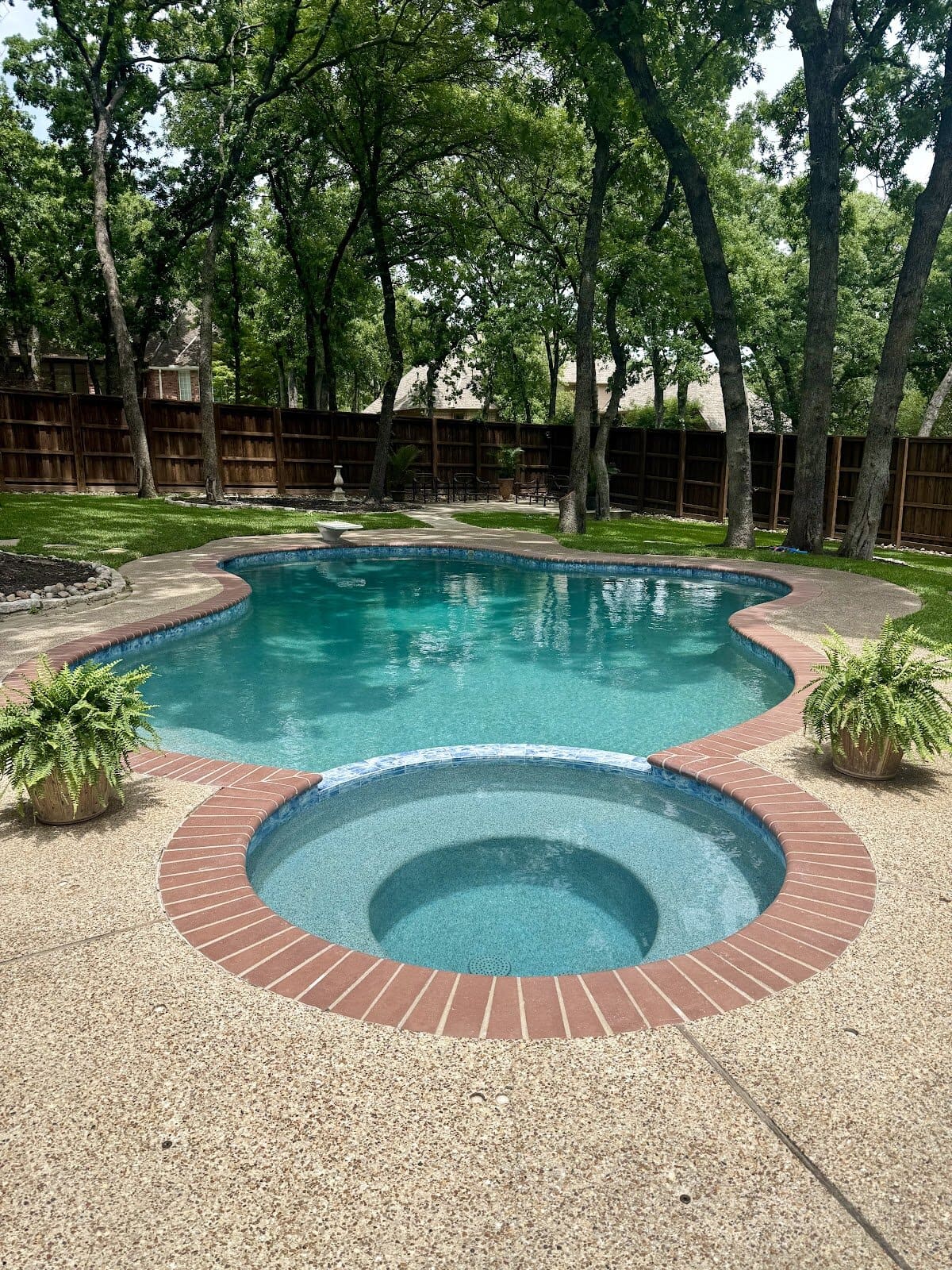
Colleyville covers about thirteen square miles between Grapevine and Southlake, and most of the neighborhoods that make it distinctive were built between the mid-1980s and the early 2000s. That era of development left something that newer DFW suburbs rarely offer: half-acre to full-acre lots with mature hardwoods, established drainage patterns, and enough setback to build a pool without the house next door looking into it.
I have built and renovated pools across Colleyville for years, and the projects there tend to follow a pattern. The homeowner has lived in the house long enough to know exactly what they want from their backyard. They are not browsing. They are ready to build, and they want to work with someone who will be on the job personally.
Why Colleyville lots are different from the rest of DFW
Most Colleyville properties sit on half an acre or more. Side-yard access is usually generous enough for equipment to get through without tearing up landscaping on both sides of the house. That sounds like a small detail, but on a tight Southlake lot or a Park Cities property with six feet of clearance, access alone can add weeks and cost to a project.
The mature trees are the other factor. Colleyville has a tree preservation ordinance, and most homeowners want to keep their oaks. That means the pool design needs to account for root zones, canopy lines, and future growth. I walk every property before drawing anything, because a pool that looks right on paper can create problems if it sits too close to a 40-year-old post oak.
Neighborhoods where I have built
Most of my Colleyville work has been in established communities: Montclair Parc, Canterbury Hills, and the larger estate lots along Pleasant Run Road. These neighborhoods share similar soil profiles and lot layouts, but each one has its own HOA process and setback requirements.
HOA review in Colleyville is generally straightforward. Most associations want a site plan, a materials list, and a fence plan. I handle the full submittal packet, and approval usually takes two to three weeks. In gated communities with architectural review boards, it can stretch to four or five weeks, but that is the exception.
Soil and engineering
Colleyville sits on the same expansive clay that covers most of northeast Tarrant County. The soil moves with moisture cycles, expanding when wet and contracting in drought. Every pool I build starts with a geotechnical report specific to the property, and the structural shell is engineered to handle that movement: steel schedules, beam depths, and bond beam dimensions are calculated for the actual soil conditions on your lot.
Drainage is the other engineering concern. Several Colleyville neighborhoods slope toward rear lot lines, and some of the older properties have French drain systems that need to be rerouted or extended once a pool goes in. Getting this right before construction starts prevents problems that surface after the first heavy rain.
Architectural Steel — Engineered and Fabricated In-House
Colleyville’s established neighborhoods along Pleasant Run and Pool Road sit on large lots with mature landscaping, and the homes are architecturally specific. When a pool project in this area calls for a cantilevered roof structure over the outdoor kitchen or a floating fire wall between the pool and spa, the structural steel behind it needs to be engineered for that property’s exact grade, setbacks, and sight lines.
I handle all of that in-house. The steel is designed, engineered, and fabricated in my own shop — not subcontracted to a third party. In Colleyville, where the existing home architecture often dictates material finishes, beam profiles, and overhang depths down to the inch, keeping fabrication under the same roof as the pool build is the only way to guarantee the finished structure belongs to the property.
I go deeper on how this capability works and what it makes possible in my overview of in-house architectural steel fabrication.
What a Colleyville project typically costs
New custom pool builds in Colleyville generally range from $150,000 to $350,000, depending on scope. A pool with a raised spa, travertine or flagstone decking, and a fire feature falls in the middle of that range. Projects that include full outdoor living spaces with kitchens, pavilions, or structural steel elements move toward the higher end.
Renovations are a significant part of what I do in Colleyville. Many of these pools are 15 to 25 years old, and homeowners are ready to update the surface, tile, and equipment without starting from scratch. A recent project involved removing an outdated spillway, replastering the shell, and upgrading to a salt system. The homeowner said afterward that the pool felt like new, and the cost was a fraction of a full rebuild.
I spec Pentair variable-speed equipment on every Colleyville project. The energy savings are measurable: most homeowners see a 60 to 80 percent reduction in pump operating costs compared to older single-speed equipment. I walk through the filtration and automation options during the design phase so nothing gets decided by default.
Renovations and what they involve
A good portion of my Colleyville work is renovation rather than new construction. Pools built in the late 1990s and early 2000s are hitting the age where surfaces need replastering, tile needs replacing, and equipment is past its useful life. Some homeowners also want to modernize the layout: removing a spillway that no longer fits the design, adding a raised spa where a flush spa used to be, or adding a tanning ledge.
I approach renovations the same way I approach new builds. I visit the property, assess the existing structure, and present a fully itemized proposal. There are no vague allowances. If the shell is sound, a renovation can give a 20-year-old pool another 15 to 20 years of life at a fraction of what a new build would cost.
How the process works
I visit the property first. We walk the yard, talk about how your family uses the space, and I take measurements and note the tree locations, grade, and access points. From there, you receive 3D renderings and a fully itemized proposal with every line item broken out.
Construction on a new pool runs 14 to 20 weeks for most Colleyville projects. Renovations typically take 4 to 8 weeks, depending on scope. I am on-site regularly and I am your single point of contact from consultation through the final walkthrough. No project managers in between, no handoff to a crew you have never met.
If you are in Colleyville and considering a pool or a renovation, the first step is a conversation. No pitch, no pressure: just a walk-through of your property and an honest assessment of what makes sense.
Call Adrian at 817.721.2452 or schedule a site visit.